
Indice
Pool waterproofing: epoxy-cement systems and resins for lasting protection
Waterproofing swimming pools: essential protection for long-lasting structures
n order to waterproof swimming pools, it is recommended to use epoxy-cement systems as they create a solid barrier against counter pressure as well as a resistant layer. Solvent-free elastic waterproofing resins protect the surface in a great way, preserving it from the aggressive action of chlorine and atmospheric agents.
The crucial importance of swimming pool waterproofing
The protection of buildings from the damages caused by water is very important for their “health”. It is also fundamental to waterproof the horizontal and vertical surfaces of swimming pools and pools in general (often made of reinforced concrete) so that the structures can remain waterproofed and perfectly efficient over time.
An important aspect to consider when waterproofing swimming pools is that the interested surfaces are generally in contact with two types of water: the groundwater and the water inside the pool itself. Because of the aggressive nature of groundwater, it is necessary to carefully evaluate its level and whether its presence is constant or temporary. As for the water inside the pool, it contains chlorine and other agents that can compromise the stability of the structure. For these reasons, the pools’ walls must be carefully waterproofed and protected.
From design to selection of epoxy systems
The construction of a swimming pool, but also any renovation of it, must therefore be carefully designed. It is not enough to waterproof, but it is also necessary to protect the surface and walls from all the aggressive agents that, over time, can compromise the artifact and its durability. And great attention must also be paid to the sealing stages of the casting joints and all those elements, such as the plant engineering part represented by the recirculation systems, water filtration andlighting that can be critical for proper waterproofing. Therefore, specific products with equally distinctive characteristics are needed to effectively waterproof swimming pools. Among the most popular, and even recommended, solutions are genuine epoxy-cement systems-that is, a judicious dosage of particular types of cement and resins- specifically designed to cross-link on damp cement substrates, both indoors and outdoors, and thus form a waterproof layer that can also withstand strong counter-thrust. These types of products-typically three-component products with also thixotropic properties-perform excellently in the task of creating a barrier to moisture even in the case of capillary rise of moisture.
Solvent-free resins and waterproofers for optimal application
After the application of this base, which is both preparatory and protective, new cutting-edge technologies suggest the application of resins and waterproofing agents, which are solvent-free and therefore less polluting. These high-performance products make it easy to carry out the work necessary to treat, restore, and prepare even the substrate of swimming pools that must bear the constant weight of water. The perfect waterproofing of swimming pools, both the horizontal flooring and the vertical walls, which are also subject to water contact, must be completed by a perfect finish. The ideal solution is the application of an elastic component with a polyurethane base, which optimally protects the surface, because it has avery high resistance to chlorine, detergents that are used for cleaning, as well as to the often damaging action of atmospheric agents, especially in marine areas, where saltiness is a constant pitfall.
Tips for proper waterproofing
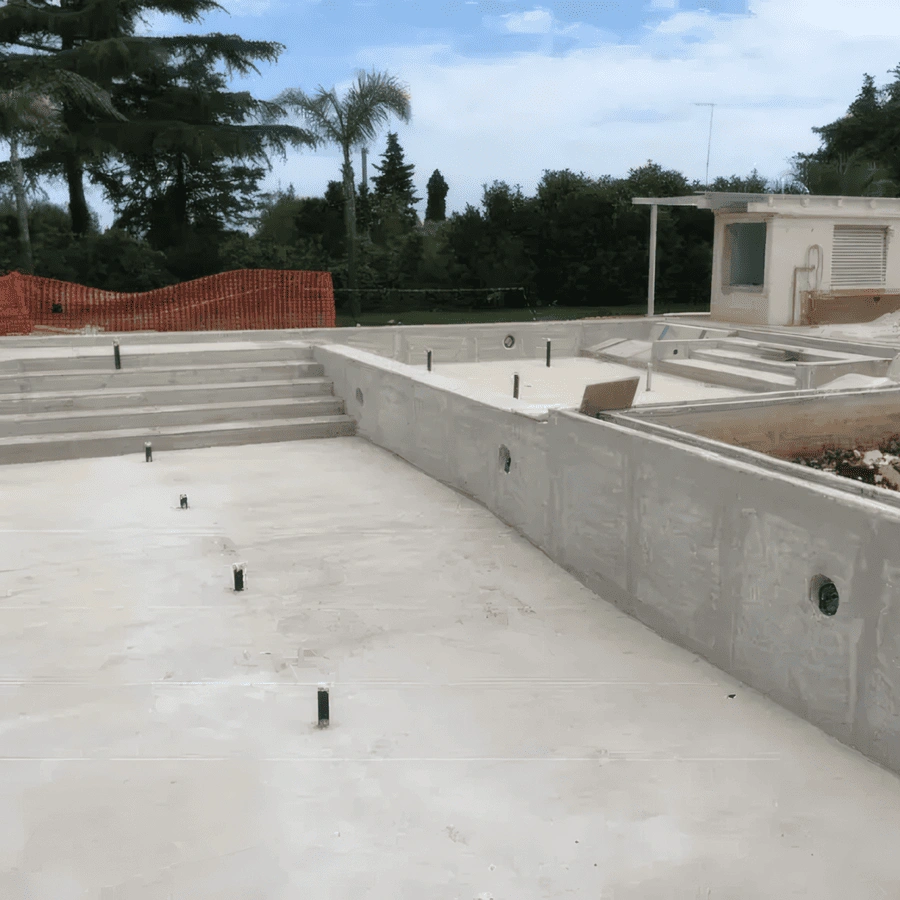
Thus, there is no shortage of solutions for carrying out professional waterproofing. These are products and systems that are as technically advanced as they are simple to apply. In order for these solutions to be perfectly effective and long-lasting, a series of attentions are required before application, starting with a careful preparation of the substrate, where it is necessary to check that there are no crumbly parts or substances that could compromise the adherence of the coating, as well as to carry out the perfect sealing of all elements that “interrupt” the linearity of the surfaces.
FAQ
Why is waterproofing a swimming pool so crucial?
Because the structure must withstand a dual assault: from the inside, chlorinated water, and from the outside, groundwater that exerts strong counter-pressure. Proper waterproofing ensures the integrity and durability of the structure.
What are the most suitable products for waterproofing a swimming pool?
The most recommended are epoxy-cement systems, which create a tenacious, waterproof barrier capable of resisting counter-pressure. They perform perfectly on cementitious substrates, even when damp, creating a solid and long-lasting foundation.
How is the internal surface of the pool protected from chlorine and wear?
After the base waterproofing, a protective finish is applied. The ideal solution is an elastic, polyurethane-based component that offers extremely high resistance to chlorine, detergents, and atmospheric agents.